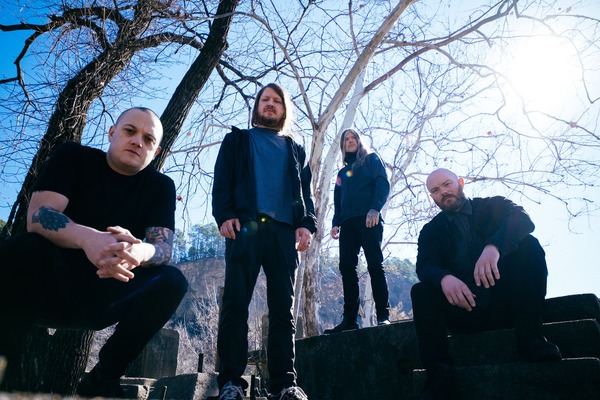
Pallbearer’s Foundations of Burden (2025 Redux) is a meticulous sonic reconstruction of their transformative, landmark 2014 album. The newly remixed and remastered version arrives digitally on Nov. 7, with physical editions (2xLP and CD) available on Dec. 5.
“During the writing and preparation for Foundations, everything was ephemeral and we were practically feral,” recalls bassist/vocalist Joseph D. Rowland. “We had no real practice space, we barely had a single working computer between the four of us. Our demos of the record consisted of something barely discernible from white noise. Nevertheless, we knew we were working towards building a set of songs we were deeply enthusiastic about.
Once in the thick of recording, the feeling went from dream to dreamlike very quickly, as we found ourselves in what felt like an endless churn of repetition. We slept at the studio on whatever soft surfaces we could find, waking each day to discover that some of the previous day’s work had been corrupted overnight. This resulted in some parts of the album being recorded many times over. The guitars in particular mutated into something Sisyphean.”
Rowland continues, “Since the time that we finally committed the original version of Foundations to print, we knew it would be a sonic space we would eventually revisit. Its form did not unfold according to the original version as the numerous file corruptions, delays, and exhausted studio budget compounded into a final feverish push to finish the mix. We were relieved to get those massive and difficult mixes turned into finished songs just in time, but not without a nagging thought; we had to sacrifice much of the nuance we had spent so much time crafting.”
More than a decade later, Pallbearer seized the opportunity to revisit the record from the ground up. Over the past year, the band meticulously reconstructed the album from the original sessions.
“In the time since then, we have played most of the songs from Foundations more times than we can count, and they remain some of our favorites,” Rowland continues. “The songs have grown with us. And while we hold a deep love and attachment to what we created in 2014, we also gained a fuller understanding of how we would want to re-present them if we had a chance. After years of discussion, listening and learning, we found ourselves in the position to fulfill that vision.”
Foundations of Burden (2025 Redux) features new mixes and mastering, plus new artwork featuring a painting by Benjamin Vierling. The six-song, 55-minute collection is produced by Pallbearer, mixed by Mario Quintero (Spotlights), and mastered by Adam Gonsalves.
In celebration of the 2025 Redux edition of their landmark album Pallbearer will be playing select shows performing Foundations of Burden in full.
—
Knoll is a Tennessee-based 6-piece "funeral grind" band formed in 2017, blending dissonant death metal, grindcore, and noise with avant-garde elements like free-jazz horns. Known for a DIY ethos, they have released three acclaimed albums—Interstice (2021), Metempiric (2022), and As Spoken (2024)—and are recognized for their intense live performances.
—
ORDH
A lot of things happen when you get older. Life gets more expensive. Aches and pains become more prominent, frequent and frustrating. The potential for isolation and loneliness is increased. Never mind being haunted by the specter of regret about what could have, should have, would have been if you only had thought things out and had a better thought out plan when your bloodstream was mostly piss and vinegar. Growing longer in the tooth can be a negative experience, if you choose to frame that way. Flip that framing and getting older is: 1) still better than the finality of the alternative, and 2) also comes with perks: wisdom, experience, growth and progression that accompanies a fiery sense of iconoclasm, confidence and independence. Should one choose to apply those positives to artistic expression, it can put spring in steps and lead to creation rooted in heartfelt singularity.
When Graham Brooks and Dylan Blake formed Barishi in 2012, they were mere kids jamming on their version of Mastodon, Baroness, Inter Arma and Gojira in garages, sheds, basements and bedrooms in and around the scenic Brattleboro, Vermont area. By the time Barishi issued their first two full-lengths (2013’s Barishi and 2016’s Blood from the Lion’s Mouth), Jonathan Hébert was beginning his tenure as the guitarist/vocalist in doom sludge graybeards Come to Grief and skulking down his own path of progression. A tour pairing Come to Grief with Barishi tour in support of the latter’s final release, Old Smoke, brought the trio into each other’s spheres and onto each other’s radars. Following the dissolution of Barishi, Brooks and Blake found themselves without a band at the same time they were tapping into a deeper and portentous conglomeration of metallic prog and filthy death metal that dared to utilize unnerving discord and poke at inky vortexes. Then, they remembered Hébert, his cavernous larynx and how they bonded over the same musical touchstones — Iron Maiden, Death, Edge of Sanity, Opeth — and Ordh was born.
“A few of the songs were written for Barishi when I was at a weird point when I didn’t know if I wanted to continue with Barishi,” explains Brooks, “So, we had some of the songs five years ago and the skeletons for the rest shortly thereafter. I hate singing and I’m not especially good at it and Jonathan was down. It just kind of snowballed, fell into place really quickly and felt really good.
“Barishi was a band that never really caught up with our tastes and what we wanted to do,” he continues. “We started that band when we were kids and we couldn’t write and play the stuff we wanted. With practicing, working and becoming better song writers we got to a place where we could. Being older and wiser I felt we could now wear our influences on our sleeves a little more and do all the things I felt some weird societal pressure to not do, like have three guitar solos in a song to satiate my inner 15 year old.”
As the sands tumbled through the hourglass, the members of Ordh — rounded out by Kiefcatcher bassist Josh Smith — drew upon their knowledge working with labels like Season of Mist and Translation Loss, becoming regulars on the regional touring circuit, and navigating the tricky waters of art and inspiration vs. deadlines and commerce. Those experiences were utilized, channelled and taken into consideration, but left to their own devices and without any industry looming over their shoulders or pressure lurking around corners, the band hunkered down to create their progressive death metal masterpiece debut, Blind in Abyssal Realms.
From the start, Ordh — the “corrupted spelling” of an old English word meaning “the tip of a spear” — have bucked trends to do things differently. Unlike the majority of today’s new bands, where the desire to put themselves, underdeveloped music and overdeveloped merch drops into the public eye as quickly as possible, Ordh took the opposite path, choosing to ruminate, simmer, write and rewrite the material that comprises Blind in Abyssal Realms over the course of five years. The result is as stunning and devastating as it is massive and hulking. “Apis Bull” roars out of the gate like a spacious colossus of sonic desecration, swimming with truncheon-swinging cavernous melodics and cacophonous harmonies. “Moon of Urd” is the deftly organized result of competing sewer-dwelling neighbors blasting their collections of ‘70s prog and spidery death metal at each other through uninsulated rice paper walls. The title track rides shotgun with the beasts of cryptozoological burden as they mimic the sound of their tearing down new buildings and three-step dancing on the remnants.
“We’re all pretty psyched about this as a snapshot of where we are now,” says Brooks. "The editing process was pretty ruthless and nothing was sacred and unless a part could prove itself, it was fair game to be cut.”
The recording process was just as labored over and extensive. Blake’s drums were originally captured in the summer of 2023. At the time, the band figured, given their protracted writing process and meticulous preparation, that the rest of the recording would quickly follow and be hastily completed. Artist Paolo Girardi (Cryptopsy, Revocation, The Black Dahlia Murder) was approached about knocking out an image to coincide with what was thought to be an impending release. A conversation with Girardi had the artist offering up an illustrative depiction of his own personal fantasy world for the cover, to which the band wisely agreed. As the recording process lumbered on, in a reversal of procedural fortune, the band began using Girardi’s cover painting as inspiration.
“The album cover is sick!” enthuses Brooks. “Paolo is the man! In terms of us telling him what we wanted, we said ‘something vaguely cave-ish,’ and that was it. He’s the master, leave the creative process to the master. He knocked out the painting so quickly that we only had drums done. But a lot of parts changed and we didn’t have all the lyrics done, so it was pretty cool to have this thing that was going to be the visual representation as inspiration. There were a lot of times we’d look at the cover and try to emulate it sonically.”
Five years on from inception and with a deal worked out with Singapore’s Pulverised Records, Ordh are finally emerging from their lengthy creative hibernation. Blind in Abyssal Realms is set to burrow its way into the earholes and consciousness of the extreme music underground with the band finally ready to bring itself to the live arena with a spate of local shows followed by concentric circle touring as their profile grows and demand increases.
“The goal with this band is more about creating something that sits well with us in the long run,” reasons Brooks. “A band that has caught up to our tastes and is something where we can do those epic song structures as opposed to when we were in Barishi and the goals were like to play this or that venue, open for this or that band or sign to this or that label — the goals you have when you’re 16 years old. I’d be lying if I said getting Ordh to a wider audience and having people enjoy it wasn’t part of the equation, but it’s mostly about maturing artistically and being the band we’ve always wanted to be.”
Blind in Abyssal Realms was produced by Ordh and recorded at Guilford Sound in Guilford, VT by Mikey Allred (Inter Arma, All Them Witches) and Matt Hall, as well as at Merle’s Tower in Dover, VT by Graham Brooks. It has been mixed by Andrew Oswald (Mortiferum, Caustic Wound, Vanum) and mastered by Brad Boatright (Come to Grief, Creeping Death) with cover art by Paolo Girardi (Cryptopsy, Revocation, The Black Dahlia Murder). The album is set to be released in spring 2026 on Pulverised Records.
Jonathan Hébert – Vocals (Come to Grief)
Graham Brooks – Guitars (ex-Barishi)
Dylan Blake – Drums (ex-Barishi)
Josh Smith – Bass (Kiefcatcher)


