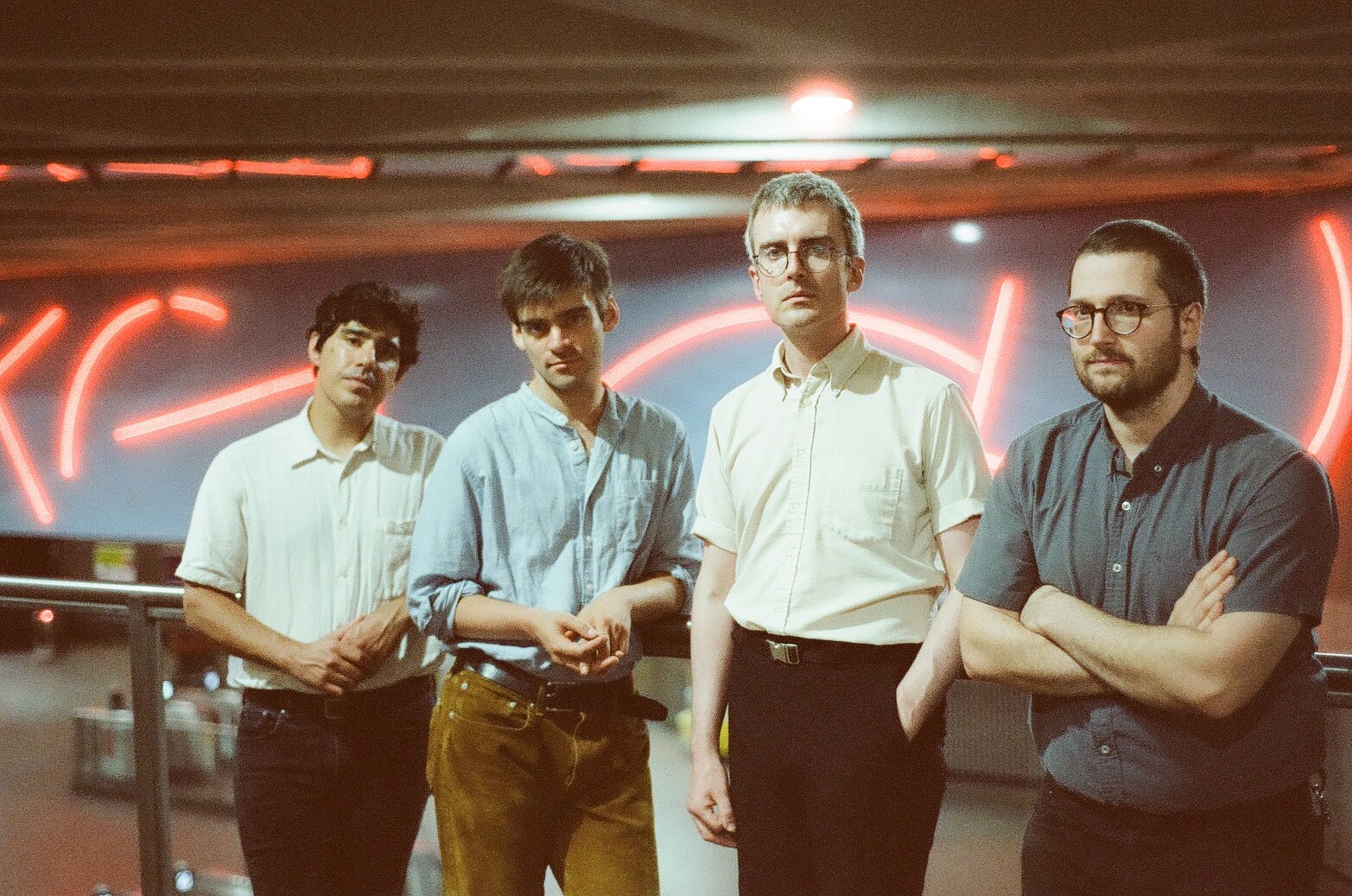
Horse Lords return with Comradely Objects, an alloy of erudite influences and
approaches given frenetic gravity in pursuit of a united musical and political vision.
The band’s fifth album doesn’t document a new utopia, so much as limn a thrilling
portrait of revolution underway.
Comradely Objects adheres to the essential instrumental sound documented on the
previous four albums and four mixtapes by the quartet of Andrew Bernstein
(saxophone, percussion, electronics), Max Eilbacher (bass, electronics), Owen
Gardner (guitar, electronics), and Sam Haberman (drums). But the album
refocuses that sound, pulling the disparate strands of the band’s restless musical
purview tightly around propulsive, rhythmic grids. Comradely Objects ripples,
drones, chugs, and soars with a new abandon and steely control.
This transformation came, in part, due to circumstance. Sidelined from touring their
early 2020 album The Common Task in a world turned upside down, Horse Lords
promptly returned to their Baltimore practice space and began piecing together the
music that became Comradely Objects (Bernstein, Eilbacher, and Gardner have
since relocated to Germany). Removed from their tried and true method of refining
new music on the road, the quartet invested less energy ensuring live playability
and more rehearsing and recording. The deliberate writing and tracking process, a
rarity since the band’s earliest days, led to a collection of pieces that signal a new
peak of creativity and musical heft without devolving into studio sprawl or frippery.
Comradely Objects reflects familiar elements of Horse Lords’ established
palette—the mantra-like repetition of minimalism and global traditional musics,
complex counterpoint, the subtleties of microtonality, a breadth of timbres and
textures drawn from all across the avant-garde—with some standout stylistic
innovations. At different moments, the album veers closer to free jazz than anything
else in the band’s catalog, channels spectral electroacoustic tones, and throbs with
unexpected yet felicitous synth. While these new elements are evidence of
additional studio time and care, Comradely Objects retains the dizzying obsessive
rhythmic energy that galvanizes the best moments of the band.
It’s vital that the Horse Lords’ instrumentals speak for themselves, and for the
quartet’s shared musical and sociopolitical vision. The title derives from Imagine No
Possessions, art historian Christina Kaier’s 2008 book on Russian Constructivist
design. Constructivists shunned the artistic egoism and precious artifacts of
capitalist art in favor of utilitarian objects for the masses. “The comradely object
should promote collective, egalitarian ideals,” the band notes. “They tended toward
simple, unadorned forms that emphasized utility and foregrounded the material.
Comradely Objects works through what this means for the material of sound, for
music, for the album, and for artistic production in the 21st century.”
Not only does Comradely Objects redefine the possibilities for Horse Lords’
shopworn format, it adds a new contour of confidence and finesse to the band’s
reliefs mounted in both sticker-spattered indie hovels and the white-walled world of
composition. It also solidifies their position among the foremost smugglers of radical
musical and political ideas into contemporary music that happens to also, after a
fashion, rock. Comradely Objects presents the most sublime document yet of the
band’s ongoing interrogation of aesthetic and social form, purpose, and intent,
alongside note, beat, and raw sound.