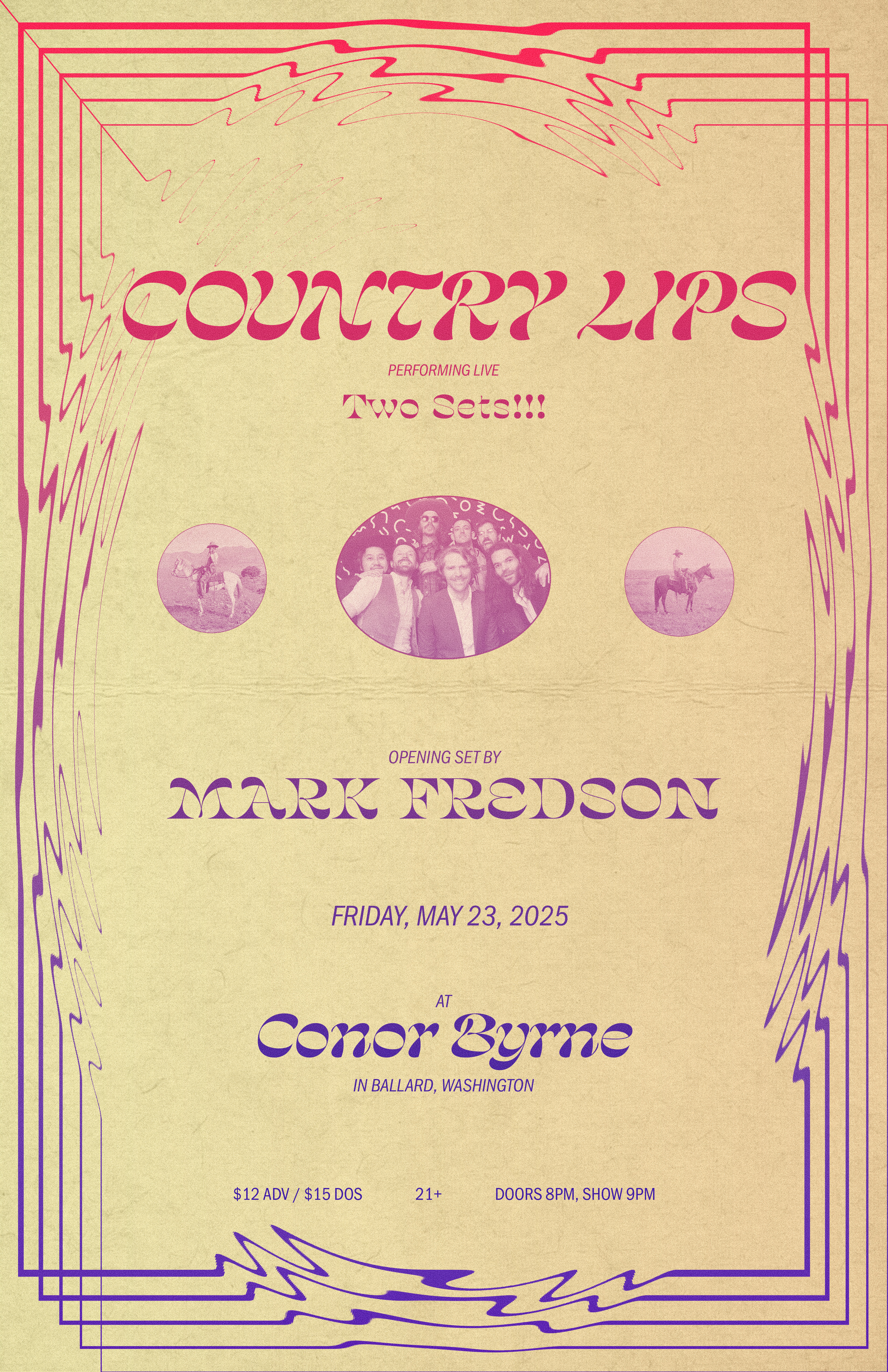
Happy to embrace the genre’s ramshackle side, Country Lips provide a welcome antidote to the increasingly polished nature of country pop. This is music to drink and dance to.
Mark Fredson's musical journey spans more than two decades, marked by a dogged commitment to the pursuit of making music for music's sake. Hailing from Port Angeles, Washington, Fredson was just a sophomore in high school when he signed his first record deal. As a frontman, songwriter, pianist, and producer, his body of work is vast, from the outlaw country of Margo Price's "Hurtin' (On the Bottle)," which he co-wrote with Price, to the theatrical pop anthems that have defined his solo career. But it's his latest album, Company Man, arriving on April 18th, 2025, that marks a a new chapter in Fredson's artistic evolution. The album explores the tension between chaotic beauty of youth and the mundane realities of growing older, all while refusing to let go of a life in service to music, even if it's sometimes more labor than love.
Fredson's high-octane days as the frontman of the Nashville-by-way-of-Port Angeles band The Lonely H had their fair share of musical highlights, but it wasn't until he went solo that Fredson's true musical identity was solidified. After releasing his debut solo album, Going to the Movies, in 2020, Fredson followed up with two debauchery-fueled full-length efforts, 2021's Nothing But Night and 2023's Outskirts. Now, with Company Man, he dives deeper into the internal conflicts brought on by the pesky hands of time and the realities of making ends meet. Across its 10 lean tracks, Fredson reckons with the challenges of making art while spending over a decade working in the restaurant industry. Was it worth it? The album continues to pose this stubborn question, even if the answer remains elusive.
With Company Man, Fredson shifts gears sonically, embracing a more polished and layered sound than ever before. Though the album retains his signature bedroom pop sensibilities - home recordings crafted largely alone in his East Nashville studio - it also benefits from new production techniques and a deeper pool of collaborators. Fredson says, "On this one I really wanted to up the production level. I tracked every song at a higher bit rate, I bought a tube pre-amp to run my vocals and keyboards through, and invested in a bunch of other gear to help make this one stand out."
The result is an album that feels fresh yet familiar, blending Fredson's influences - classic rock, indie pop, and soft rock - with a modern sheen. Aided by an impressive roster of some of Nashville's best, Company Man introduces a rich, layered sound that signals Fredson's growth as a producer. "It's my most extensive musician credit list of any of my albums by far," Fredson reflects. "Whereas the previous albums all had mainly one player on each instrument throughout the whole album, on this one I really dug heavily into my rolodex and called upon a bunch of different players I've come to know over the course of my time in Nashville. Three different bassists, three drummers, three guitarists, my trusty saxophonist, a couple string arrangements later, and you've got a pretty stacked credits list."
For Fredson, moving back to his childhood home on the Olympic Peninsula played a significant role in the creation of Company Man. After spending close to 14 years in Nashville, Fredson made the decision to leave, citing a natural end to his time in Music City. "No one wants to be the last one at the party, that's what I keep telling myself. You know, I did my time in Nashville, and I'll always look back on my time there fondly. Probably more fondly the longer I'm away. But in the end, I arrived at the conclusion that it was time to take a bow and leave with my head held high, or at least not with my tail between my legs." Now back in the Pacific Northwest, Fredson has found new inspiration in the stunning natural surroundings of his hometown. "I can play and make music anywhere, and I'd much rather do it surrounded by family and the indisputable natural beauty of the Olympic Peninsula. I mean, It's kinda hard not to be inspired up here."
Fredson admits that while the songs on Company Man were written before his move back to Washington, the sentiment of his impending departure permeates through the record, especially on the album's final track, "That's That." The song serves as both an emotional farewell to Nashville and an embrace of a new chapter, if not lyrically, at least sonically. "The song sounds hopeful but thematically it's pretty sad. Some of my favorite pop songs have that juxtaposition between light, cheery music and darker lyrical elements, and that's what I was going for with this one. It's like I'm finally giving up on being cool, but hey at least there's marimbas! 'All the prizes won from when I was young meant next to nothing then and nothing to me now' is one of my favorite lyrics and also one of the toughest pills to swallow, probably because the truth hurts."
Company Man captures a musician in transition - reflecting on the years that have passed, reconciling with the decisions made, and confronting the looming prospect of mid life in the not too distant future. Fredson's taken a long hard look in the mirror and his expectations have been adjusted accordingly. Sure he may not be the young gun he once was, and maybe he lost the firm grip he once had on his dreams as a result. But if Company Man is any indication, he'd be well advised to hang on to them for dear life.


